There is a sentence I hear in almost every local authority I work with:
“We’ve already got a provider for that.”
It’s not said dismissively.
It’s said with reassurance. Certainty. A sense of compliance.
On paper, it makes perfect sense.
If you have a commissioned provider in place, it feels like the need is “covered”.
But here’s the uncomfortable truth:
Having a provider is not the same as meeting need. And it is definitely not the same as changing the system.
This misunderstanding is one of the biggest reasons local authorities end up commissioning activity rather than outcomes, initiatives rather than behaviour change, and coverage rather than capability. It’s one of the traps that keeps demand rising even when contracts are full and services are technically “performing”.
And it’s one of the clearest signals that a local authority is stuck in what I described in the previous article as the High‑Effort, Low‑Proof Trap.
Today, I want to unpick this, gently but honestly, so we can build a commissioning strategy that truly transforms the experience of children and families.
Activity coverage is not need coverage
Let me start with a simple example.
A local authority commissions a specialist domestic abuse provider to also support children affected by domestic abuse. The contract is solid. The KPIs are being met. Sessions are delivered. On paper, everything is working.
But underneath the surface:
- families are missed - it’s impossible for this one provider meet the need across a large geographical area
- frontline early help practitioners are de-skilling themselves through their signposting role
- waiting lists grow faster than capacity
- early help arrives after escalation
The provider is delivering their contract.
But the system is not changing.
Because a contract can only ever touch a small part of the need.
The rest sits with the workforce you already employ- your early help workers, family support practitioners, youth teams, safeguarding officers, and those across your Family Hubs and targeted services.
If these practitioners are not confident, equipped and consistent in their trauma‑informed practice, the commissioned provider will never be enough.
Why “provider-first” commissioning quietly fails
Local authorities often default to provider-first commissioning for understandable reasons:
- They recognise they don’t have the specialist skills and knowledge internally to deliver
- It produces clean activity data.
- It appears to “fill a gap” without requiring internal structural change.
- It provides a safety net for scrutiny panels and regulators
But here’s the issue:
Provider-first commissioning solves a service offering, not capability or capacity.
And capability and ability to access early help is what changes children’s trajectories.
Because what children experience most frequently is not specialist commissioned services.
It’s the frontline practitioners.
Day in, day out, children have contact with early help teams, family support workers, youth workers, Family Hub practitioners, schools, social care and multi‑agency partners.
This is where the impact of trauma is either identified early or missed.
This is where relational safety is either created or lost.
This is where the trauma cycle is either broken or reinforced.
Commissioned providers cannot change the system if the system doesn’t change around them. It’s also very frustrating for the commissioned providers because they can see the impact the system is having on families and their help-seeking experience.
Commissioning for adoption, not attendance
The most strategic commissioners I work with no longer say:
- “We can do this ourselves”- there is a realisation that eliciting help from experts will help them progress further. If they had the internal expertise, it would already be in place right?
- “We will only train practitioners working within domestic abuse services” – it’s recognised that not all children and families affected by domestic abuse will have contact with specialist services.
- “What if we train them and they leave” – investing in the workforce through training, providing resources and access to ongoing support increases job satisfaction. Practitioners can see the difference THEY are making and that helps services retain their team.
Instead, they ask:
- “What is the best strategy to roll this out across the workforce so its adopted?”
- “What do we need our workforce to do differently?”
- “What needs to change internally/ what do we need to consider so all our services align with trauma-informed practice?
- “How are other local authorities embedding this, we want to learn from them”
This shift from funding provision to commissioning system behaviour is what allows trauma‑informed practice to become embedded, not episodic. It’s one of the core principles within this article series.
Using the Healing Together programme to bridge the gap
Local authorities often ask me:
“But if we already have a domestic abuse provider, why do we need something else?”
And my answer is always the same:
You don’t need “something else”. You need “something different”.
Healing Together is not a replacement for specialist services. It’s a programme that enables children to access early help by people they already know and trust. It’s to prevent them from needing the specialist services. Not every child needs a specialist service but those that do can’t get timely access. By getting rid of the bottleneck, you are enabling children to access early help and specialist support if necessary.
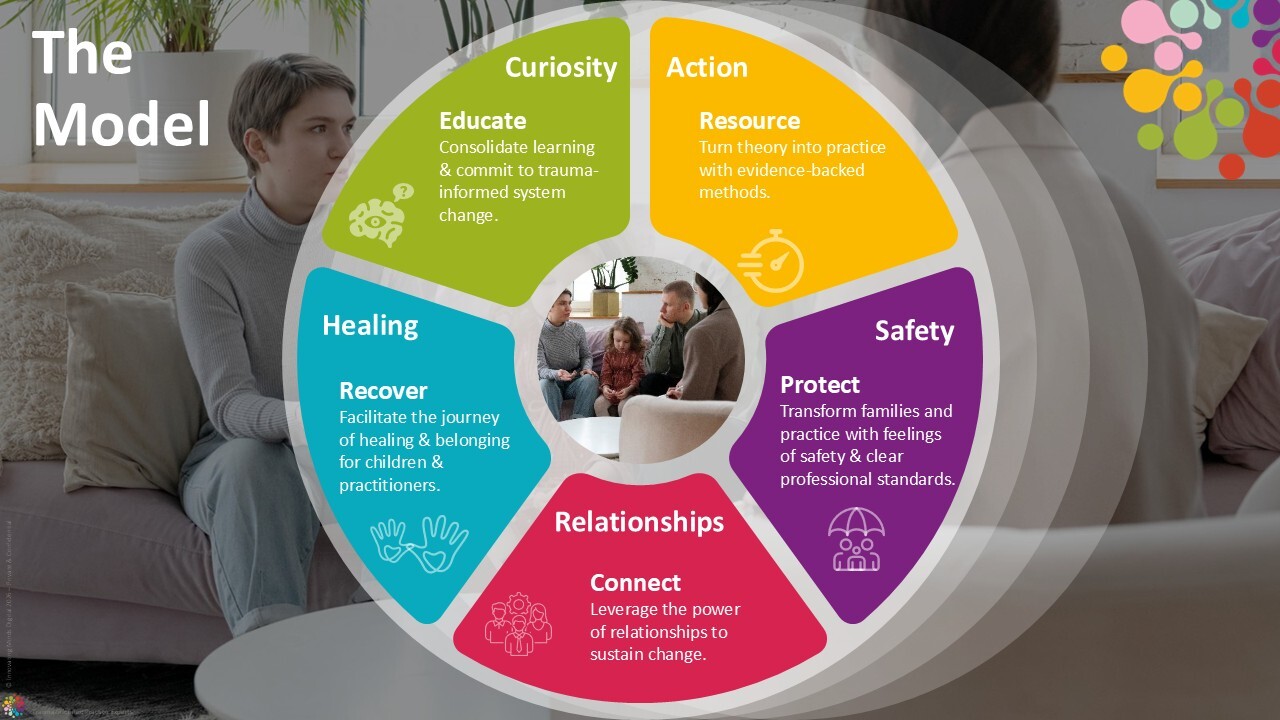
The Healing Together programme embeds trauma‑informed practice through the five-stage model I created ‘Breaking the Cycle of Childhood Trauma’:
1. Curiosity
Educating frontline practitioners and consolidating their learning in recognising the impact of trauma and how to become trauma-informed practitioners.
2. Action
Resourcing staff with simple, clinically backed programme resources they can use immediately, without referral routes or waiting lists.
3. Safety
Professionalising practice with instilling a culture of professional standards and practice such as assess to clinical support, coaching, CPD and measuring the impact of their work.
4. Relationships
Leveraging the power of connection and relationships with senior leaders, colleagues and families to achieve incredible impact at scale.
5. Healing
Facilitate the journey of healing and recovery for both children and practitioners. Practitioner wellbeing is just as important because the cost of caring is real.
This model of system change sits within the existing workforce. It’s a proven model that has been adopted nationally by local authorities.
Are you interested to learn more about the model?
Book a call with Dr Asha Patel to explore it in more detail.
How this looks in practice (a real example)
A local authority told me they felt confident in meeting the needs of children affected by domestic abuse because they “already commissioned a provider”.
But the commissioned provider (on the same day) explained to me that they currently did not have the capacity to explore the Healing Together programme themselves because:
- They had experienced a high staff turnover so didn’t have the internal stability to upskill their team (short term funding cycles doesn’t help with staff retention)
- They had a waiting list and couldn’t meet current demand for children accessing help
- This issues with their team had been going on for 3+ months.
In this instance the local authority had become dependent on the provider without recognising the strain it was placing on them. As a result, the provider can’t provide a positive help-seeking experience for children and families, and the local authority are not meeting their statutory duties. The cycle will continue until a strategic commissioner or service manager is willing to make bold commissioning decisions.
The commissioning questions that matter most
Finally, here are some questions you may want to ask yourself before extending and renewing commissioned services.
- Does this provider deliver a service that our frontline practitioners can offer?
- Can the impact beyond outputs be measured?
- Does this commissioned provider reduce service variation across localities?
- Is the system within the local authority hindering or supporting the commissioned provider?
- Is it reasonable to expect one commissioned provider to meet the local demand?
One commissioned provider cannot do this alone. It requires a system approach that involves a multi-disciplinary team response.
Interested to learn more? Talk to us about a pilot in your local authority.

Next up in the series
Why Old Commissioning Models Are Turning the Most Expensive Resource into Sign‑Posters. We’ll explore how current commissioning unintentionally de-skills your workforce — and how to fix it.


