You can meet every statutory duty, commission a “good” local provider, and still watch demand rise, crises spike, and scrutiny tighten. I know how that feels because the people who pay the highest price are children and the frontline practitioners who want to help them but can’t change the operating conditions they work within.
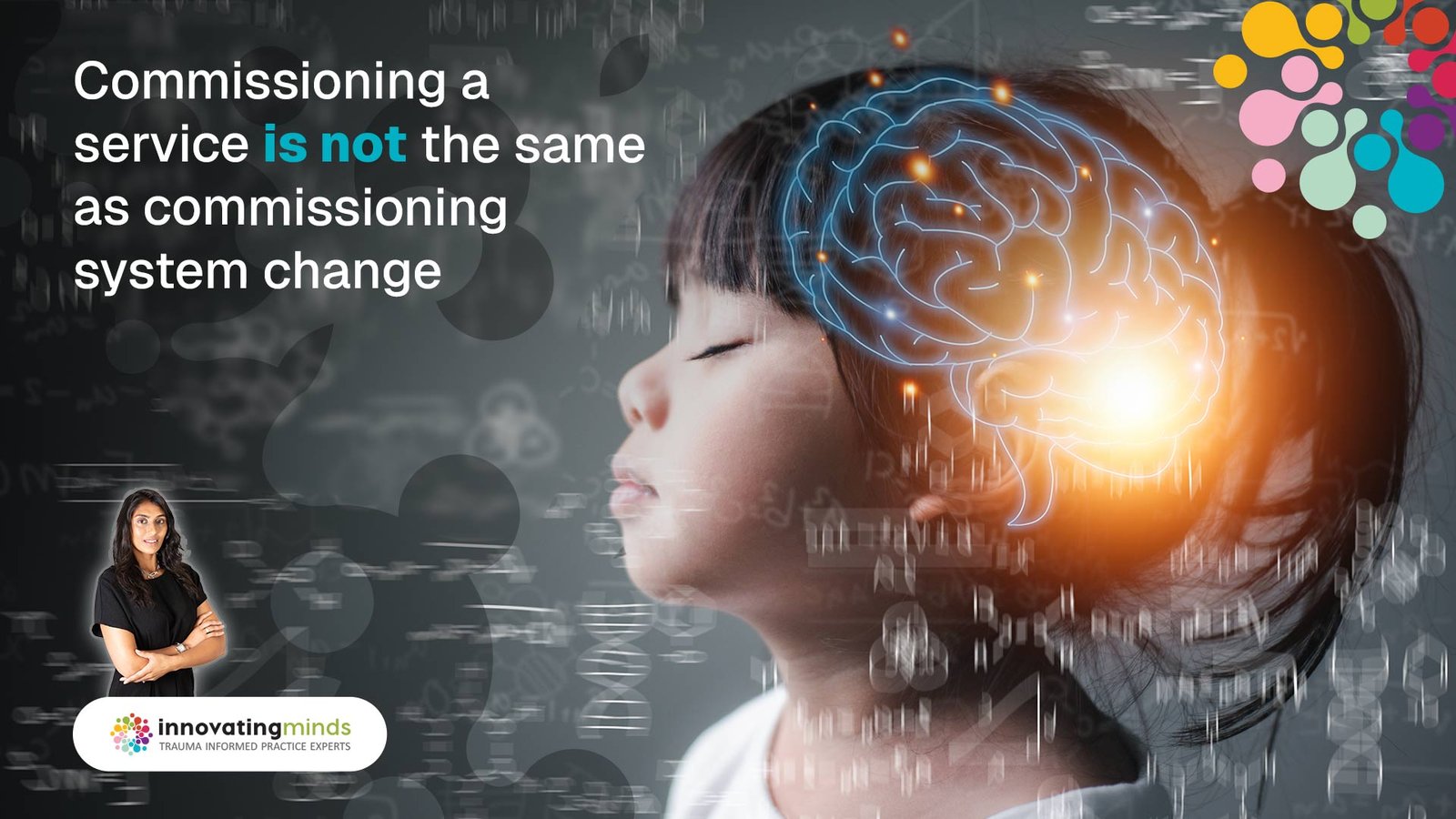
The uncomfortable truth is this: commissioning a service is not the same as commissioning system change. The former buys activity: the latter changes what children, families and front-line practitioners experience.
The risk no one names out loud
When budgets shrink and scrutiny grows, the default is to protect what already exists: extend a contract, add more sessions, run another round of training. It’s quick, looks like action, and gives you something to stand behind at scrutiny. But too often it leaves you with the worst combination, high effort, low proof, and a workforce that feels more like a signposter than a supporter.
In my early career, working with individuals convicted of serious violent and sexual offences, one pattern haunted me: almost all had lived through profound childhood trauma, surrounded by adults who cared but hadn’t been equipped to respond early enough. That’s why I built Healing Together to embed trauma‑informed practice inside the systems children already access, not as another initiative or new team, but by upskilling the existing workforce so help lands earlier and becomes part of everyday practice.
Outputs don’t equal outcomes
It’s easy to count referrals processed, assessments completed, and sessions delivered. It’s harder and more meaningful, to evidence prevention: fewer escalations, earlier help that sticks, more consistent practice across localities, and families who stop retelling their story to every doorway. That’s the evidence leaders, auditors and Ofsted want when they ask, “What changed for children?” And it’s what practitioners feel when they finally have the tools and permission to help rather than triage.
Commission an operating rhythm, not an initiative
If your goal is early harm prevention, commissioning “more of the same” won’t get you there. Training alone rarely changes practice in high‑pressure systems. People attend; everyone agrees; then the day job wins.
What works is commissioning an operating rhythm, a simple, repeatable way to translate strategy into day‑to‑day behaviour across schools, early help and social care. This is how trauma‑informed practice becomes “how we do things” rather than something extra.
Here’s the mindset I encourage commissioners to adopt:
- Be honest without blame. Name what isn’t working: delays, handoff failures, repeated storytelling, re‑referrals at the same points.
- Specify behaviours, not slogans. If you can’t describe what will look different next week, you’re commissioning aspiration, not change.
- Own implementation. Name internal owners, cadence, and support for practitioners. Don’t outsource the “missing middle”.
- Make it easy to say yes. Bring a plain‑English model, clear operational changes and defensible measures leaders can stand behind.
- Measure prevention, not just activity. Build a spine that proves earlier help, fewer crises and reduced variation.
A practical, defensible playbook for early harm prevention
1) Start with uncomfortable curiosity: what are we tolerating?
Get specific about where the system fails families in predictable ways. Which children cycle back? Where do thresholds and culture, not need, drive decisions? Which points in the journey ask families to repeat themselves? This isn’t a “needs assessment”; it’s de‑risking future spend.
2) Define the change in one sentence — then list the behaviours that prove it
For example: “Early help lands before crisis, and frontline practitioners are equipped to disrupt the trauma cycle.” Now make it observable:
- Shared language and resources across schools, early help and social care
- Predictable responses
- Joined‑up responses to trauma (not postcode practice)
- Practitioners proactively using micro‑practices with families, not just signposting
3) Commission implementation (not just training)
Training can be necessary; on its own it rarely changes practice. Commission the embed:
- Named internal owner(s) who unblock barriers
- Weekly or fortnightly cadence to check adoption
- On‑the‑job support, supervision and simple tools practitioners actually use
- A plan for when the next pressure wave hits (because it will)
This is the difference between “we had trauma‑informed training” and “practice has shifted inside our existing teams.” It’s also the heart of Healing Together: embedding within current pathways and roles, avoiding new teams or high‑budget restructures, and equipping the adults children already trust.
4) Build leadership safety before you sell it upward
Have a strong pitch: the gap you’ll fix, the model you are proposing, operational ownership, and evidence how it will stand up to challenge. Social proof matters too. Being “first” can feel risky; demonstrate how the model is already being adopted nationally, this will feel safer.
5) Measure what proves prevention
Outputs are useful, but they are not your safety net. Your impact data should answer:
- Are fewer families escalating to specialist services?
- Is help landing earlier… and staying there?
- Is variation in access to help across localities reducing?
- Do practitioners report they can do meaningful work (not just pass families on)?
- Do families experience less repetition and more trust?
A short vignette
Kent County Council integrated the Healing Together programme within their Family Hubs after seeing a growing number of young children affected by domestic abuse with no dedicated support available to them. Many children were arriving at family hubs dysregulated, angry, and unable to engage in learning or relationships. Through the Family Hub Practitioners delivering the Healing Together programme, children were given safe, playful spaces to understand their feelings and calm their bodies, while parents learned simple, effective co-regulation strategies. Within weeks, staff saw remarkable change: children who had been excluded from classrooms were re-engaging, building friendships, and coping more confidently. Families left better equipped, with skills that will support wellbeing long beyond engagement with the Family Hub team.
Common pushbacks and how to answer them
- “Practitioners don’t have the time”
Exactly, practitioners time is finite and therefore how they spend their time to create the most impact is what we should be focusing on. Practitioners spending their time signposting to services or completing lengthy referral forms for children to sit on waiting lists is not a good use of their time. Practitioners that are equipped to directly work with children and families and offer meaningful trauma-informed support is time well spent. - “We can’t afford something new.”
You are already paying — in salaries, repeat training that doesn’t translate, initiatives that fizzle, inconsistent practice, and avoidable escalations. The question isn’t “new vs not”. It’s: are utilising the biggest resource we are paying for (salaries) effectively? - “We’ve tried initiatives before.”
That’s not proof change is impossible; it’s proof that change without ownership, embed and cadence it won’t work.
The commissioning shift that changes everything
Commissioning “more” rarely buys safety. It buys busyness. You’ll be judged not on effort but on evidence that children experienced something different: earlier, safer, more consistent. That’s why the safest route is commissioning system behaviour: clear ownership, practical support for the workforce you already have, and measures that prove prevention.
Next up in this series: The High‑Effort, Low‑Proof Trap: How Children’s Services End Up Busy but Not Safer — I’ll show how to spot it early and pivot toward an operating rhythm you can defend.
Talk to us about a pilot in your local authority. We’ll co‑design a minimal‑friction starting point that embeds trauma‑informed practice within your existing pathways and roles; no new teams, no high‑budget restructure, and measurable outcomes that stand up to scrutiny.