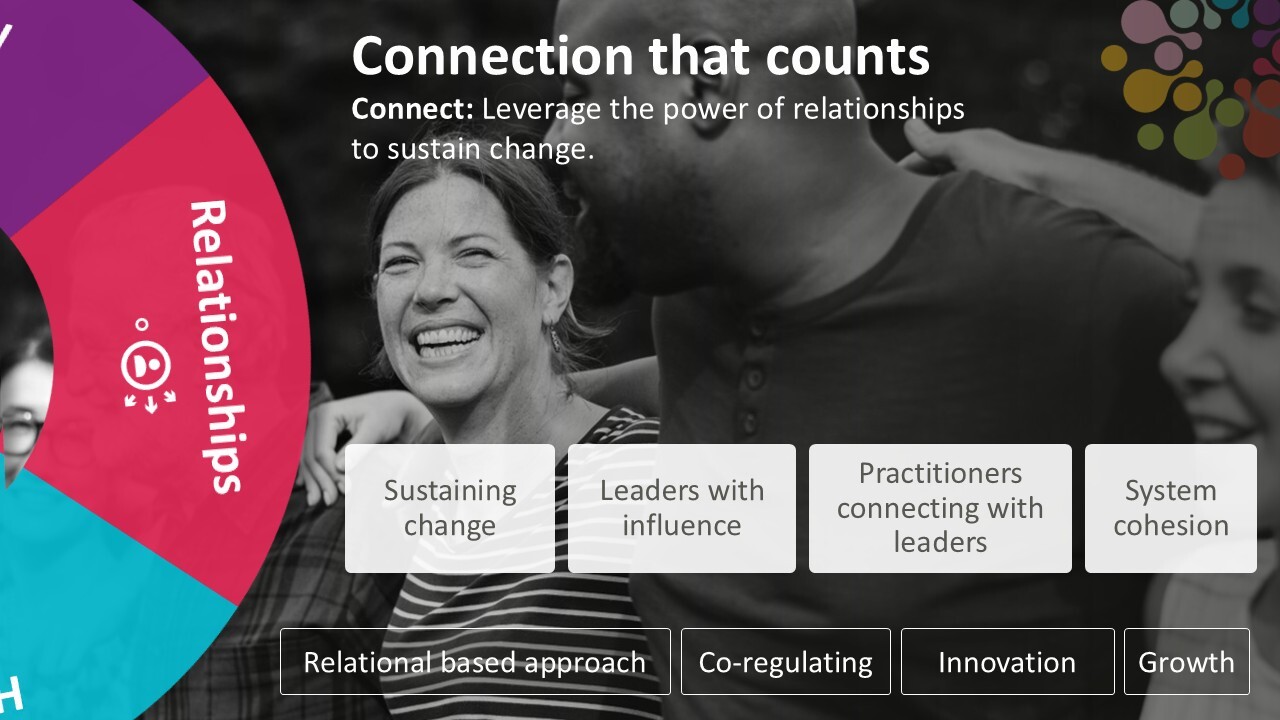
When services talk about transformation, the conversation often centres on strategy, governance, performance and implementation.
These things matter.
Every successful change programme requires clear direction and strong leadership.
However, there is another factor that plays an equally important role and is often overlooked.
Relationships.
Within the Healing Together Framework, relationships are not viewed as an optional extra or a soft skill.
They are the mechanism through which sustainable change becomes possible.
The reality is simple.
-
People change through relationships.
-
Teams change through relationships.
-
Systems change through relationships.
If we ignore this, we risk creating strategies that look impressive on paper but fail to take root in practice.
Relationships are where healing happens
Trauma occurs within relationships.
Healing also occurs within relationships.
This understanding sits at the heart of trauma-informed practice.
Children and families often begin healing when they experience safe, consistent and trusting relationships.
The same principle applies within services.
Practitioners need trusted relationships with colleagues, supervisors and leaders.
Teams need trust to navigate uncertainty and change.
Leaders need trusted partnerships to influence wider systems.
Without these connections, sustainable change becomes significantly harder.
The danger of transactional systems
Many public services are operating under extraordinary pressure.
-
Caseloads are rising.
-
Demand is increasing.
-
Resources are stretched.
When this happens, services naturally focus on efficiency.
Unfortunately, relationships can become unintended casualties.
-
Interactions become transactional.
-
Conversations become shorter.
-
Opportunities for reflection disappear.
-
Partnerships become focused on process rather than shared purpose.
Over time, this weakens the very connections that sustain effective practice.
It becomes harder for people to collaborate, innovate and adapt.
Relationships create belonging
One of the most powerful outcomes of trauma-informed implementation is connectedness.
When teams feel aligned around a shared purpose, something important begins to happen.
Practitioners no longer feel isolated.
Managers become more accessible.
Leaders become more visible.
People feel part of something larger than themselves.
This sense of belonging supports wellbeing, motivation and retention.
It also creates the conditions for trauma-informed practice to become embedded rather than dependent on a handful of passionate individuals.
Leaders with influence matter
One of the most overlooked aspects of implementation is the role of influential leaders.
Successful trauma-informed systems rarely emerge because of one leader acting alone.
They spread because leaders build relationships with other leaders.
-
They create alliances.
-
They share learning.
-
They influence strategic decisions.
-
They align priorities across agencies.
This is particularly important within family hubs, local authorities and integrated services where meaningful change often depends on multiple services moving in the same direction.
Relationships help ideas travel.
Relationships help change scale.
Moving beyond organisational boundaries
The challenges facing children and families do not sit neatly within one service.
Mental health, education, safeguarding, social care, family support and community services are deeply interconnected.
This means trauma-informed practice must extend beyond organisational boundaries.
Services that achieve lasting impact are often those that invest in relationships across the wider system.
-
They build trust with partners.
-
They create opportunities for shared learning.
-
They align around common goals.
Most importantly, they recognise that no single organisation or service can create system change alone.
Reflection questions for leaders
Consider the following questions:
- Where in our service are relationships strongest?
- Where are relationships being lost or weakened?
- How connected do practitioners feel to the wider vision?
- Which relationships are critical to implementing trauma-informed practice successfully?
- Are key leaders and partners aligned around a shared purpose?
The answers often provide valuable insight into both barriers and opportunities.
Change travels at the speed of trust
Many implementation plans focus on structures, actions and milestones.
These are important.
However, meaningful change often moves at the speed of trust.
Where trust exists, collaboration becomes easier.
Learning becomes safer.
Innovation becomes possible.
Where trust is absent, even the best ideas can struggle.
This is why relationships sit at the heart of the Healing Together Framework.
Not because they are a nice addition.
But because they are the foundation on which sustainable change is built.
Want to learn more about the Healing Together Framework?
📞 Book a call with Dr Asha Patel
Next reading
Healing: when trauma-informed practice becomes "how we are"
Discover what success looks like when trauma-informed practice becomes embedded into culture, identity and everyday practice.
eager to learn more? Sign up to the waiting list to read more about our upcoming exclusive webinar series with Dr Asha Patel and special guests. Reserve your seat as we are limited in space.